Every marketing account on the internet has told you some version of the same thing: don't just sell, give value first. Gary Vaynerchuk built an entire book around it, "Jab, Jab, Jab, Right Hook" — mostly value-giving content, with the sales pitch as the occasional right hook. It sounds right. It also sounds like exactly the kind of thing that gets repeated because it's catchy, not because anyone checked.
So we checked. We wanted a straight answer to two questions: is there real evidence that non-promotional content (a beer garden in the sun, a regular's dog, a Tuesday-afternoon photo of nothing in particular) actually outperforms a straightforward "book your table" post? And if it does, why, and what does that mean for what a pub should actually post on a Tuesday?
The answer to the first question is yes, and the "why" turns out to matter more than the headline number.
The numbers
Non-promotional content outperforms direct sales content by a wide, consistently-measured margin. A cross-industry digital intelligence study reported by Retail Dive found non-promotional posts got double the engagement of overtly promotional ones. Hospitality-specific benchmarking from Eighty Days puts the gap at +75% for storytelling and brand-identity content over direct offers.
A peer-reviewed study out of Universidade Católica Portuguesa, analysing real Facebook brand page performance, reached the same conclusion from an academic angle: promotional posts don't outperform non-promotional ones, and over-promoting measurably hurts a page's engagement over time.
Two content categories stand out specifically:
| Content category | Average Instagram engagement rate | vs. platform baseline (1.55%) |
|---|---|---|
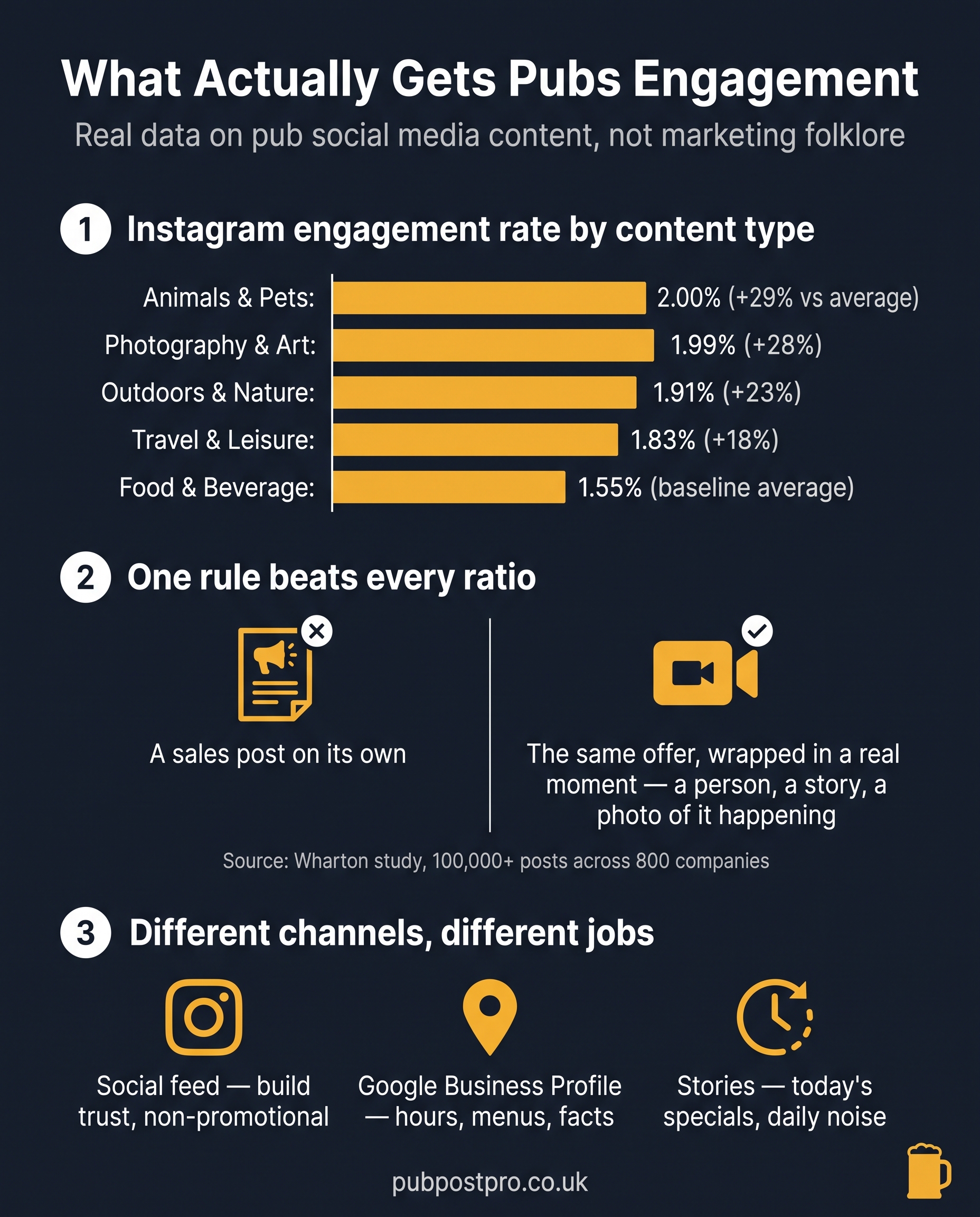
| Animals & Pets | 2.00% | +29% |
| Photography & Art | 1.99% | +28% |
| Outdoors & Nature | 1.91% | +23% |
| Travel & Leisure | 1.83% | +18% |
| Food & Beverage | 1.55% | baseline |
That data comes from CreatorFlow's benchmark analysis of over 63 million Instagram posts across 600,000 accounts — a large enough sample that the pattern isn't noise. Dedicated pet-content research from specialist firms puts genuinely pet-focused accounts even higher: 3.2% to 5.0% engagement, three to five times a general lifestyle baseline.
If your pub has a beer garden or a regular with a dog, you're sitting on two of the three highest-performing content categories that exist on the platform, and neither has anything to do with your food or drinks menu.
This isn't a fringe interest either
"Dog friendly pub near me" pulls an estimated 15,000-25,000 UK monthly searches — the same order of magnitude as "pub quiz near me," and not far off "sunday roast near me" (30,000-50,000). Being genuinely, visibly dog-friendly isn't a nice-to-have niche angle. People are actively searching for it.
The part that actually matters: why this happens
Here's where it gets more useful than "post more dog photos." A landmark study out of Wharton (Hosanagar et al., analysing over 100,000 Facebook posts across 800 companies) found something more specific than "sales posts are bad."
Isolated informative content — a post that's purely about price, availability, or an offer, with nothing else going on — genuinely does depress engagement. But the same informative content, wrapped in a persuasive, emotional, or narrative frame, performs fine.
That's the actual finding, and it's more useful than the popular version of it. The lesson isn't "stop posting about your Sunday roast." It's "never post about your Sunday roast on its own." A photo of a carvery with "Sunday Roast, Book Now" underneath is the exact kind of isolated informative post the Wharton data says underperforms.
A short video of your kitchen team carving the beef, with a line about where it's from and a soft mention that Sundays fill up fast, is the same information wrapped in a story — and it's the format the data says actually works.
Why audiences push back on pure sales content
The flip side is documented just as clearly. Sprout Social's own Index found 57.5% of social media users say they're actively annoyed by excessive promotional posts from brand accounts, and 46% cite over-promotion as their specific reason for unfollowing a business entirely.
Another 41-45% cite "irrelevant or purely transactional content" as a second major reason to leave. People don't mind a pub selling something. They mind a pub that only ever does that.
Doesn't this fight against needing to be found on Google?
This is the tension we expected to find, and it turns out not to really exist, once you separate what each channel is actually for.
Local search (Google Business Profile, Google Maps) rewards accurate, frequent, information-dense updates: hours, menus, events, review responses. That's exactly the kind of content the Wharton study says underperforms *on social media specifically*. So which is right?
Both are, because they're not competing for the same job. Your Instagram and Facebook feed is where you build reach and trust — the "jab" work, using content that earns saves, shares, and comments, the exact signals the platform's own algorithm rewards with wider distribution.
Your Google Business Profile is where you convert someone who's already decided to look you up — that's where the plain, informational, no-narrative-required content belongs, because at that point the person searching already wants the transactional facts.
Two channels, two jobs. Keep the sales-flyer-style posts off your main social feed and onto your Google listing and your Stories, where "just the facts" is exactly what's wanted.
A real example, not a theory
The best UK case study we found for this isn't a marketing case study at all. The Devonshire in Soho, run by Oisín Rogers and Charlie Carroll, sells around 20,000 pints of Guinness a week and keeps a fully booked grill room, without running discount promotions or paid ads.
Its social content is almost entirely unscripted: kitchen team cooking on the open grill, cellar work, staff and regulars just being themselves. No offers, no "book now" flyers, and it's one of the most talked-about pubs in the country right now.
That's the whole argument in one example. The content isn't selling anything. It's why people already want to go.
What to actually post
Here's the practical version, not the theory. Think in terms of a rolling weekly mix rather than a rigid daily formula — the research doesn't support an exact ratio (3:1, 80/20, and similar rules are popular but not themselves scientifically validated), but it does support this shape:
| Slot | Focus | Example |
|---|---|---|
| Human / craft | Staff personality, cellar care, kitchen prep | A short video of tapping a fresh cask, or the chef talking through tonight's special |
| Atmosphere / heritage | Beer garden, open fire, local history | A seasonal beer-garden shot, an old photo of the pub next to a modern one |
| Community / relatable | Pub dogs, local events, pub-culture humour | "Dog of the Week," a nod to something happening locally |
| Hybrid "right hook" | A real commercial ask, narrated, not just a flyer | The roast being carved, captioned with where the meat's from, ending with a soft booking mention |
Cap the un-narrated, flyer-style promotional posts at roughly one in five of your main-feed content. Route daily operational noise (today's guest ale, tonight's availability) to Stories instead of the main feed. Keep your Google Business Profile as its own, separate, purely informational channel — hours, menus, events — since that's exactly the job it's suited to.
Key sources: engagement benchmark data from CreatorFlow's 2026 Instagram benchmark analysis; the Wharton study on content and engagement by Hosanagar et al.; unfollow/fatigue data from the Sprout Social Index; hospitality benchmarks from Eighty Days.
Want a ready-made month of this to follow?
We built a free example content calendar showing exactly what to post, when, and how often, based on this research — no sign-up wall, just a plan you can follow starting Monday.
Get the free example month