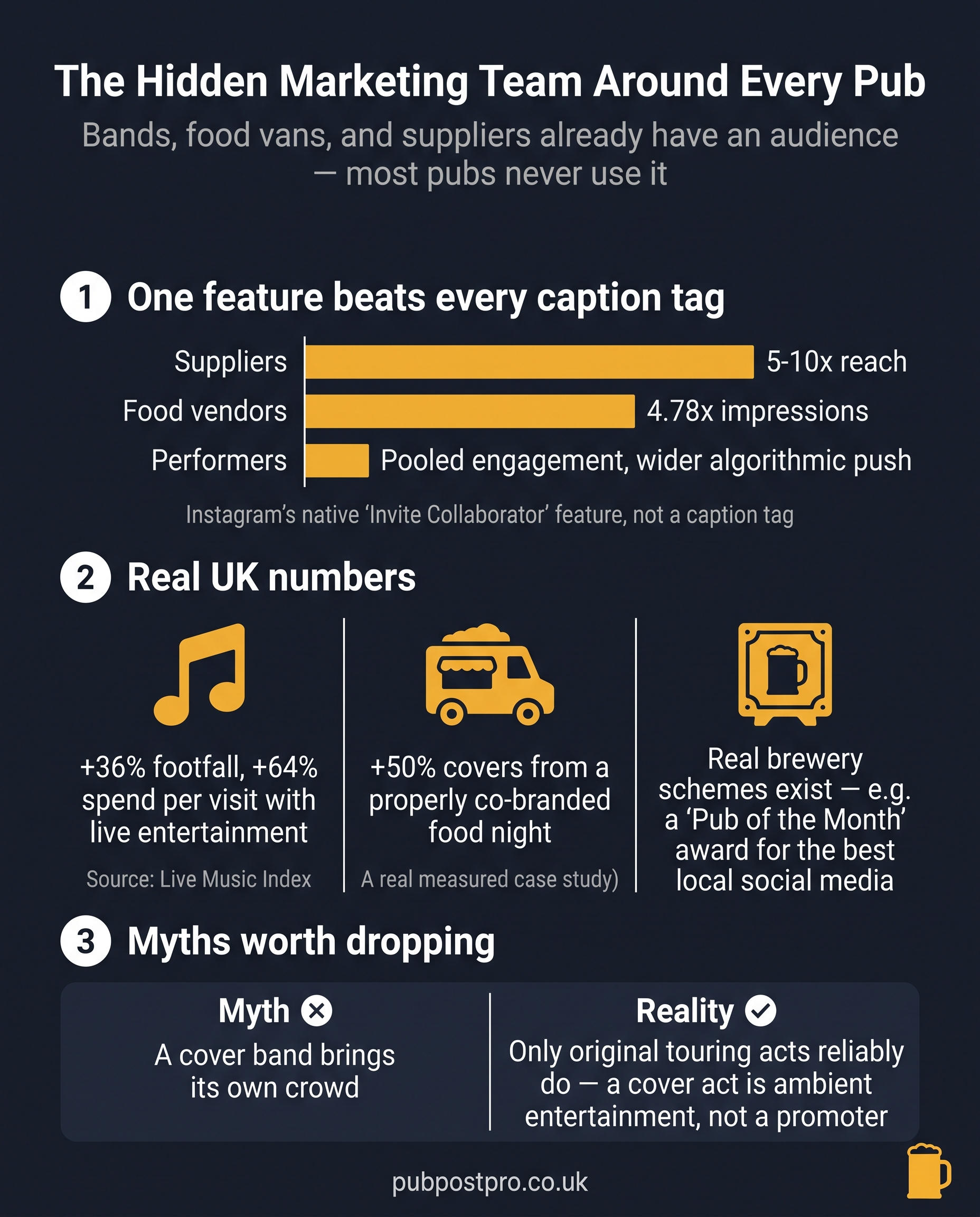
Most pub marketing advice is about the pub talking to its own followers. But a pub isn't a closed system. On any given week, a landlord is dealing with a performer, maybe a food van, and always a brewery or a supplier — three separate businesses, each with their own audience, their own reasons to want the partnership to go well, and in most cases, completely untapped as a marketing channel.
We went looking for real evidence on what actually works with each of these three relationships, and found something we didn't expect: the same fix appears in all three, independently.
The one thing that changes the maths on all three
Tagging a performer, a food van, or a brewery in a caption feels like promotion. It mostly isn't. A tagged account gets filed into a secondary "tagged" tab that almost nobody checks, and the post never reaches the tagged party's own followers at all. Three separate pieces of research, covering three completely different partnership types, all converged on the same specific fix:
| Partner type | Plain caption tag | Native Instagram Collab post |
|---|---|---|
| Food vendors | Baseline (1.0x) | 4.78x more impressions, 4.39x more interactions |
| Suppliers | 1.05–1.2x reach | 5–10x reach expansion |
| Performers | Isolated to one account's followers | Pooled likes/comments/views across both accounts, stronger algorithmic push |
Instagram's "Invite Collaborator" feature publishes a single post natively to both accounts' main grids simultaneously, pooling the engagement from both audiences into one signal. It's free, it's already in the app, and almost nobody managing a small business account actually uses it instead of a plain tag. This one change is worth more than most of what follows.
Performers: what's real, and what's a myth worth dropping
Live entertainment genuinely moves the numbers. The CGA/GigPig Live Music Index, surveying over 500 UK venues and 1,000 performers, found venues with live entertainment see +36% footfall, +33% total sales, +64% spend per visit, +61% dwell time, and +48% visit frequency compared to venues without it.
But here's the claim worth retiring: the idea that booking a singer or a covers band brings a room full of their fans. Gigging musicians are consistently and specifically clear on gigging-musician forums that this mostly isn't true for standard pub bookings.
An original touring act with their own fanbase might travel with people. A flat-fee solo singer, cover band, or resident DJ playing a normal Friday night pub set is, in their own words, ambient entertainment — the crowd is the pub's job, not theirs. Landlords who scold performers for a quiet turnout on a flat-fee booking are pushing back on an expectation that was never really evidenced in the first place.
What actually gets a performer to promote you
The tactic that's genuinely validated: stop handing performers a pre-gig poster, and start sending them a short video of their own actual set afterwards. The numbers back this up specifically — static promotional graphics average 0.36-0.40% engagement; short-form video (the Reels format) averages 1.24%, roughly three times higher.
But the more important reason it works is that a good live clip is genuinely useful to the performer — it's portfolio footage for their own next booking, so they keep it, and keep resharing it, for months. A flyer is dead the moment the gig ends.
Film 3-5 short vertical clips during the set. Edit and send them to the performer within 24-48 hours, as an Instagram Collab invite, not a download link. This gives the performer something they actually want, and it's the mechanism the research says works.
Recurring hosts play a different game entirely
A weekly quiz host or resident DJ isn't trying to import a fanbase — they're becoming a local personality in their own right, and that's a slower, more valuable mechanism: rotating quiz formats specifically show 20% higher customer retention than a static one, and the same visit-frequency and dwell-time gains from the Live Music Index compound weekly rather than spiking once.
Treat a recurring host as a long-term partner, not a rebooked act.
Food vans: a real deal structure, not just "food van here tonight"
For a wet-led pub without its own kitchen, a standard guest food night lifts wet sales 3-5%. A properly co-branded, high-capacity pairing (think a match-day screening plus a food van, both promoted together) can lift draught volume 31.5-53%, with kick-off-window spikes over +550%.
The commercial logic worth remembering: the value to the pub isn't the food margin, it's new customers through the door spending on drinks — that reframing changes how a booking should be judged.
The deal structure that actually gets a vendor to promote it
NCASS (the UK's trade body for independent caterers) is specific about what makes a booking worth a trader's own promotional effort. Their "Times Four" rule: gross sales need to be roughly four times the pitch fee just to cover a trader's costs. A high flat fee on a routine midweek night kills their incentive to tell anyone about it.
The evidenced structure is a **zero fee on quiet nights, or a 10-15% sales-share model** — both parties only win if the night actually works, which is exactly the incentive alignment you want.
Traders also need **21-28 days' lead time** to fold a booking into their own social calendar — anything shorter gets no real promotion from their side, regardless of how good the deal is.
Real UK results, not theory
The King & Co in Clapham runs a structured 1-3 month kitchen residency model with named street food brands, generating fresh press coverage each rotation. Kegbelly in Cardiff started as taproom pop-ups between a brewery and a food van and became a permanent, fully co-branded venue.
And in a directly measured case, two independent traders running a genuinely co-branded joint promotion (Chouxly Scrumptious x Wilson's Street Food) saw a **50% increase in covers** compared to trading solo — a real number for what actually co-branding a night is worth versus just listing "food van here tonight" as one line in a post.
One risk worth knowing before you sign anything
If a food van sells its own soft drinks, coffee, or desserts, it directly undercuts a pub's own highest-margin non-alcoholic sales. A simple written agreement reserving all beverages for the pub bar heads this off before it becomes friction on the night.
Suppliers: the schemes are real, but nobody's coming to find you
The biggest myth here: that breweries and distillers are quietly scouting good independent pubs to feature. They're not. Co-marketing with a supplier is a reactive process — it only happens when a landlord or their agency puts together a complete, ready-to-approve package and hands it directly to the sales rep or account manager, not a cold message to a corporate social account.
Real, named UK schemes with actual entry criteria
This is the most directly useful finding in all three reports. These aren't hypothetical — they're live UK brewery programmes:
- Timothy Taylor's "Champion Club" — six months of permanent line placement, strong volume, and passed cellar/dispense audits earns a venue a physical plaque, custom pump clips and glassware, and features on the brewery's own consumer channels.
- Joseph Holt's "Pub of the Month" — judged not just on volume but explicitly on local social media execution and community engagement. One winning pub (The Stonemill in Warrington) was recognised specifically for its social content around dog-friendly days and community events, earning regional press coverage and brewery-funded promotion off the back of it.
- Theakston's stockist support — branded POS, glassware, and coordinated regional marketing for permanent stockists.
If a pub's social media is genuinely part of what qualifies it for a scheme like this, that's not an abstract marketing benefit — it's a specific, named, real-world outcome worth pointing out directly to a landlord.
Go local, not national
Naming a local farm, butcher, or micro-roaster in a post gets an estimated 80%+ chance of a reshare — small local suppliers actively watch their own tags and are glad of the mention. Tagging a multinational lager or spirits brand gets under 1%; those accounts run centralised national campaigns and essentially never reshare independent venue content outside a formal partnership.
The consumer data backs the local angle too: 78% of UK diners say local or regional provenance matters when choosing where to eat.
Real, sustained partnerships beat one-off tags
Shakespeares, a free house in Sheffield, permanently rebadged an Abbeydale Brewery cask as "Dave's Deception" after a regular, runs joint tap-takeover events during Sheffield Beer Week, and has served over 8,800 unique casks since reopening — a genuine long-term commercial relationship, not a single post.
Northern Monk and Timothy Taylor's went further still, co-developing an actual beer (Northern Rising) launched jointly across both breweries' channels and their independent stockists.
How to actually do this
| Partner | Before | During / after |
|---|---|---|
| Performer | Set realistic expectations (they won't import a crowd), agree who's filming, pay promptly | Send 2-3 edited clips within 48 hours as a Collab invite, not a download link |
| Food van | Agree zero-fee or 10-15% sales share, 21+ days' notice, reserve drinks for the bar | Co-branded graphics, both accounts post, joint Collab invite for the event |
| Supplier | Package a full proposal (date, assets, Collab invite ready to accept) for the actual sales rep | Ask about formal stockist schemes once a line's been permanent 6+ months |
None of this requires a bigger budget. It requires treating three relationships a pub already has as marketing partnerships instead of logistics to manage.
Key sources: the CGA/GigPig Live Music Index; NCASS trade guidance on street food pitch economics; Timothy Taylor's, Joseph Holt, and Theakston's own published stockist programmes; and Emplifi's benchmark data on Instagram Collaboration posts.
We run these partnerships as standard, not an add-on
Collab posts with your performers, food vendors, and suppliers are part of what we do for every pub we work with — not a separate service. If you want to see what this could look like for your pub specifically, we're currently offering a small number of free pilot spots.
Apply for a Free Pilot Spot